
In Revelation 1:10 John hard a loud voice tell him to write the book and send it to the seven churches of Asia (symbolically seven means complete, so this was a message for all churches).
When he turned around to see where the voice was coming from he saw one like a son of man among the seven golden lampstands that represented those churches.
“One like a son of man” is a messianic title from Daniel chapter 7 connecting Jesus to both humanity and divine glory, appearing with the characteristics of the “Ancient of Days,” showing He is both God and man.
“Son of Man,” which first occurs in the Bible at Mark 2:10, is an ambiguous title, largely free of the political and military connotations associated with Messiah. In itself the title does not appear to have made any special claim in the ears of Jesus’ contemporaries. Nowhere are people amazed that Jesus calls himself the “Son of Man,” for example, nor do they take exception to his doing so. “Son of Man” thus offers the advantage of a title unencumbered by unwelcome associations, allowing Jesus the possibility of speaking of himself in public, indeed often in the face of opposition and hostility, in such a way that his hearers might discover his identity, if they would discover it at all.
“Son of Man” occurs fourteen times in Mark, and only from the mouth of Jesus. As in the other synoptic Gospels, “Son of Man” is divided into three categories in Mark.
- In three instances (Mark 8:38; 13:26; 14:62) it occurs in apocalyptic contexts, as in its usage in Daniel 7 and 1 Enoch 37–69, where it refers to the Son of Man coming in judgment.
- Twice the title refers to Jesus’ earthly authority to forgive sins (Mark 2:10) and supersede the Sabbath (Mark 2:28).
- Its most predominant usage, however, is with regard to Jesus’ suffering (nine times: Mark 8:31; 9:9, 12, 31; 10:33, 45; 14:21 [twice], 41).
Each of the three categories refers to a divine attribute, or, as in the case with the third, fulfilling a divinely ordained purpose. It is thus apparent that “Son of Man” is not, as is often supposed today, merely a circumlocution for “the human one.”In Mark 2:10 “Son of Man” depicts Jesus’ authority to forgive sins, thereby alluding to the “One like a Son of Man” figure in Dan 7:13–14 (as does John in Revelation 1:13), who likewise is empowered with God’s authority. He was given authority, glory, and sovereign power.
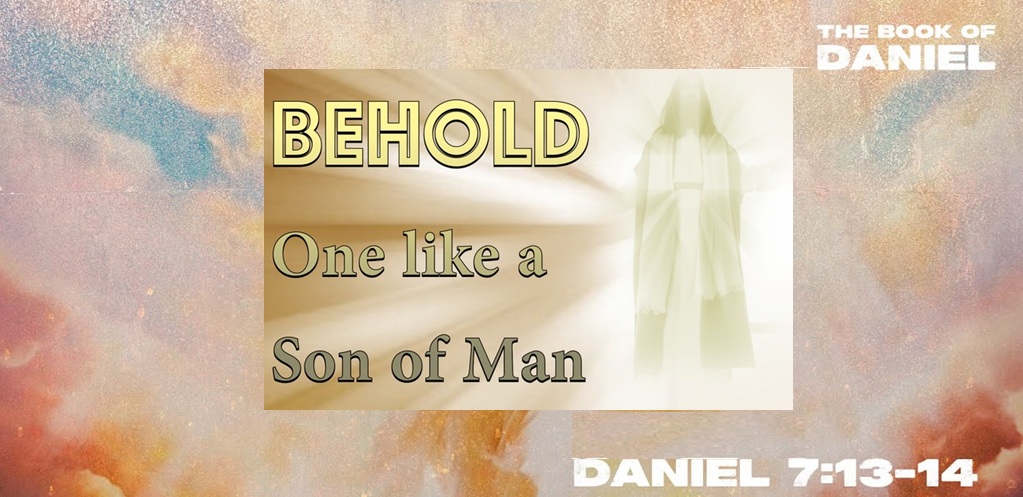
Daniel 7:13 probably provides more directly relevant background. In his vision, Daniel sees “one like a son of man,” that is, one who is apparently human, yet, this individual was “coming with the clouds of heaven.” He approached the Ancient of Days and was led into his presence. He was given authority, glory and sovereign power; all nations and people of every language worshiped him. His dominion is an everlasting dominion that will not pass away, and his kingdom is one that will never be destroyed (Daniel 7:14).
Daniel 7:13,14 seem to suggest more than this — that Israel will be led by a representative who is described as a heavenly figure worthy of universal worship (an unlikely attribute for monotheistic Jews to ascribe to themselves as a whole!
In 1 Enoch and 4 Ezra, Jewish pseudepigraphal works completed no later than the end of the first century, the Son of Man appears clearly as an individual and a messianic figure. Demonstrably pre-Christian works also point to at least a minority voice within Judaism that would have agreed. The Greek definite article may function as a demonstrative: “this ‘Son of Man’,” that is, the one described in Daniel.
Some Jewish interpretations see the “Son of Man” as symbolizing the righteous saints or the nation of Israel, who ultimately receive the kingdom from God, as mentioned in verses Daniel 7:18, 27. The upshot of all of this is that, contrary to popular contemporary Christian (mis) conceptions, “Son of Man” winds up being a very exalted title for Jesus.
It does not primarily focus on his true humanity but on his heavenly enthronement (notice also the plural “thrones” of Daniel 7:9). It is more of a synonym than an antonym of “Son of God.”
But it remains ambiguous enough that Jesus was able to invest the term with His own meaning and clarifications. It was not susceptible to the political misunderstandings surrounding the term “Messiah” itself. The possibility of linking it with suffering was not one that pre-Christian Jews had unambiguously exploited.
Whereas Daniel’s Son of Man travels on the clouds to the very throne room of God, Jesus uses this imagery to describe His return from heaven to earth in glory (Mark 14:62).
Christians see this figure as Jesus, fulfilling the prophecy during His trial and ascension, representing His divine nature and future reign.
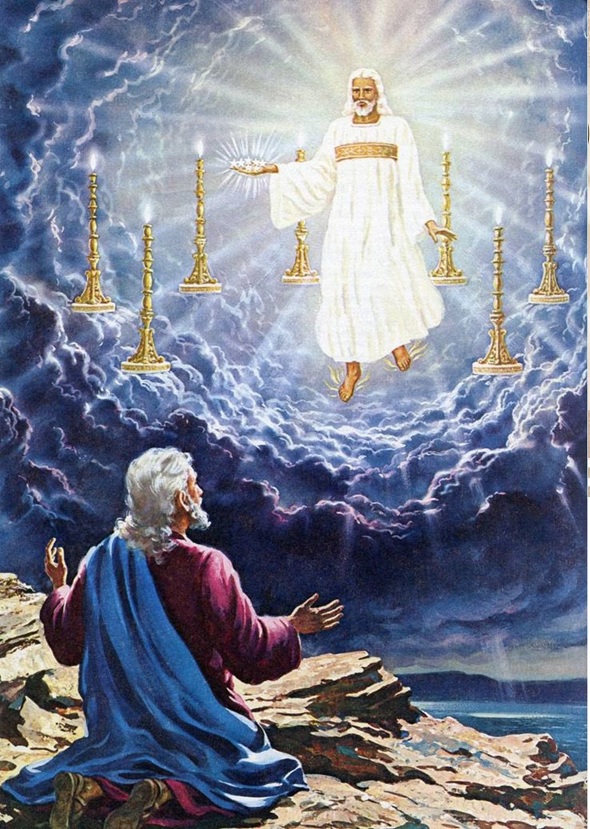
Like Daniel’s description of the Son of Man, John’s vision isn’t just a scary image; it’s a revelation of Jesus’ glorious power and intimate care for His church. It serves as a comfort (He’s with you) and a warning (He judges) for believers, assuring them He’s in control and their light should shine brightly as His representatives.
John described a long robe and golden sash (Revelation1:13) which symbolize His priesthood and perfect righteousness (like a High Priest).
John said He had white hair and eyes like fire (Revelation 1:14). White signifies purity/eternity; fiery eyes suggest intense scrutiny and judgment.
John said He had feet like bronze (Revelation 1:15) which represents steadfastness, purity, and judgment.
John heard a voice like roaring waters (Revelation 1:15) which shows His powerful, majestic authority.
John said He has a face like the sun (Revelation 1:16) which signifies His dazzling glory and divine power.
______________Affiliate link – SHOP: _______________
_This ad is for my favorite version of The Bible _
_____but click on it to browse the whole store______


NASB Comfort Print Thinline Bible, Red Letter Edition–bonded leather, burgundy (click here)
By Zondervan
The beloved 1995 Edition of the New American Standard Bible is now easier to read with Zondervan’s exclusive NASB Comfort Print® typeface. This edition of the NASB Thinline Bibles is available in a variety of sophisticated designs in a portable, easy-to-read format.
- The full text of the New American Standard Bible, 1995 Edition
- Exquisite, durable covers
- Less than one inch thick
- Double-column format
- Presentation page
- Two satin ribbon markers
- Words of Christ in red
- Exclusive Zondervan NASB Comfort Print 9 point type
Features:
____________________________________________
In conclusion, consider the Daily Bread email message sent on 1/2/2026 which says:
Revelation 1:13-16 – and in the middle of the lampstands
I saw one like a son of man, clothed in a robe reaching to the feet, and girded across His chest with a golden sash. 14 His head and His hair were white like white wool, like snow; and His eyes were like a flame of fire.
15 His feet were like burnished bronze, when it has been made to glow in a furnace, and His voice was like the sound of many waters. 16 In His right hand He held seven stars, and out of His mouth came a sharp two-edged sword; and His face was like the sun shining in its strength. (NASB)
To receive the Daily Bread email messages, free on Mon., Wed., and Fri., in your email inbox, just fill in the form below or send an email, and ask to be added, to jmikeh@jmhowington.com